PET Bottle Blowing Machine Preform Heating Temperature: Guide & Optimization
In the PET bottle blow molding process, PET bottle blowing machine preform heating temperature is one of the most critical factors that directly determine bottle quality. If PET bottle blowing machine preform heating temperature is too low, the preform will not soften enough, leading to insufficient stretching, thick bottoms, and uneven walls. If PET bottle blowing machine preform heating temperature is too high, the preform will over-soften, causing sagging, thinning, or even burning. Mastering the optimal PET bottle blowing machine preform heating temperature range and adjustment methods can significantly improve yield rates, reduce defects, and maintain stable production. This guide covers the key principles, recommended ranges, common defects, and practical optimization tips for PET bottle blowing machine preform heating temperature.
Recommended PET Bottle Blowing Machine Preform Heating Temperature Range
The standard PET bottle blowing machine preform heating temperature for most PET preforms ranges from 85°C to 120°C, depending on preform material, wall thickness, and bottle design. For general-purpose PET preforms, the ideal surface temperature is typically between 95°C and 110°C. The core of the preform (especially near the gate) should be slightly cooler, while the body needs uniform heating to ensure even stretching.
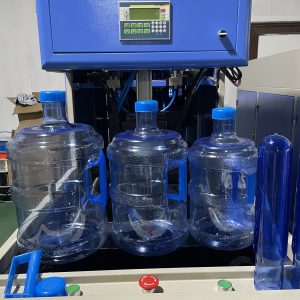
Thicker preforms require higher PET bottle blowing machine preform heating temperature and longer heating time to fully soften the material. Small preforms for 500ml bottles usually need lower temperatures, while large preforms for 5-gallon bottles require more heat to achieve uniform softening. The neck area of the preform must remain unheated to preserve thread shape and sealing performance, so it is important to adjust oven lamps to focus heat on the body only.
Why PET Bottle Blowing Machine Preform Heating Temperature Matters
The purpose of PET bottle blowing machine preform heating temperature is to soften the PET material to its optimal glass transition state, allowing uniform stretching during blow molding. PET resin softens at around 70°C and becomes fully moldable between 85°C and 120°C. If PET bottle blowing machine preform heating temperature is too low, the material will resist stretching, leading to heavy bottoms, off-center bases, and uneven wall thickness. If the temperature is too high, the material will lose structural integrity, causing the preform to sag or thin out during stretching, resulting in weak bottle walls or burst bottles.
Even small variations in PET bottle blowing machine preform heating temperature can affect the material’s viscosity and flow characteristics. A 5°C difference in oven zone temperature can change the material’s stretch ratio by more than 10%, directly impacting bottle quality and consistency.
Common Defects Caused by Improper PET Bottle Blowing Machine Preform Heating Temperature
Thick or Off-Center Bottle Bottoms
Insufficient PET bottle blowing machine preform heating temperature in the base area is the main cause of thick or eccentric bottoms. If the preform base remains too rigid, the stretch rod cannot push the material evenly, leading to heavy centers or uneven wall distribution. Increasing the heating power for the base section can help soften the material and improve stretching.
Thin or Weak Bottle Walls
Excessively high PET bottle blowing machine preform heating temperature causes the preform body to over-soften, making it too stretchable during blowing. The material stretches too far, resulting in thin, weak walls that are prone to bursting or deformation under pressure. Reducing oven power or adjusting lamp distance can help lower the temperature and improve material strength.
Neck Deformation
Heating the neck area too much can cause thread deformation or shrinkage. This is usually caused by improper oven lamp alignment or too high PET bottle blowing machine preform heating temperature near the neck. Adjusting the oven shields to block heat from the neck area is essential to prevent this defect.
Cloudy or Milky Bottle Appearance
Uneven heating, especially when PET bottle blowing machine preform heating temperature is too low, can cause the material to crystallize, resulting in cloudy or milky bottle walls. Consistent and even heating throughout the preform body is key to maintaining transparency.
Sagging or Drooping Preforms
If PET bottle blowing machine preform heating temperature is too high, the preform will soften excessively and start to sag under its own weight before blowing. This causes uneven material distribution and distorted bottle shapes. Lowering the oven temperature or reducing heating time can prevent sagging.
Step-by-Step Adjustment & Optimization for PET Bottle Blowing Machine Preform Heating Temperature
Calibrate the Oven Temperature Zones
Most PET bottle blowing machine ovens have multiple temperature zones (top, middle, bottom). Adjust each zone independently to match the preform shape. For tall preforms, increase power in the middle and bottom zones; for short preforms, focus on the middle section. Keep the neck zone temperature low to protect threads.
Adjust Heating Time and Preform Speed
The longer the preform stays in the oven, the higher its temperature will rise. Adjust the oven chain speed to control heating time. For thick preforms, reduce speed to allow more heating time; for thin preforms, increase speed to avoid overheating.
Optimize Lamp Distance and Shielding
The distance between infrared lamps and preforms directly affects PET bottle blowing machine preform heating temperature. Closer lamps provide more heat, while farther lamps provide less. Use heat shields to block excess heat from the neck and base areas. Clean lamps regularly to maintain consistent heat output.
Monitor Preform Temperature Uniformity
Use an infrared thermometer to measure preform surface temperature at different sections. Adjust lamps or zones to eliminate hot or cold spots. Rotate preforms evenly in the oven to ensure all sides receive equal heat.
Fine-Tune with Trial Runs
After setting initial PET bottle blowing machine preform heating temperature, run small batches of test bottles. Check wall thickness, transparency, and base shape. Adjust the temperature in small increments (2–3°C) to find the optimal setting for your specific preform and bottle design.
Preventive Maintenance Tips for Stable Heating Temperature
Clean infrared lamps and reflectors regularly to remove dust and oil residue, which reduce heat efficiency.
Calibrate oven temperature sensors periodically to ensure accurate readings.
Check oven ventilation to prevent heat buildup and uneven temperature distribution.
Replace aging lamps that produce inconsistent heat output.
Document optimized temperature settings for each bottle model to speed up future setup.
Conclusion
PET bottle blowing machine preform heating temperature is a foundational parameter that directly affects bottle quality, production efficiency, and yield rates. By understanding the recommended temperature range, common defects, and practical adjustment methods, manufacturers can achieve uniform heating, consistent stretching, and high-quality bottle forming. Regular calibration, cleaning, and trial runs are essential to maintaining stable PET bottle blowing machine preform heating temperature and avoiding costly defects. Whether operating a semi-automatic or fully automatic line, optimizing the heating process will bring significant improvements in product quality and production stability.